
Filing for Divorce in New York Without a Lawyer
Plenty of people in New York get divorced without hiring anyone. If your situation is genuinely straightforward, the state provides free forms and a guided program to help you do it, and the only unavoidable cost is the court’s own fees.
This guide covers how the process actually works, who qualifies for the free program, what it costs, and — just as importantly — the situations where handling it yourself tends to go wrong. Filing for divorce is a major change and often an emotional one. Knowing what to expect at each stage removes at least the procedural uncertainty.
Contested or uncontested: the distinction that decides everything
Before anything else, work out which kind of divorce you have, because it determines whether self-filing is realistic at all.
In an uncontested divorce, both spouses agree on every term: the division of assets and debt, child custody and support if there are children, and spousal maintenance. Nothing is left for a judge to decide. This is faster, cheaper, and the only situation where filing without a lawyer is straightforward.
In a contested divorce, there is disagreement on one or more issues. That means extended proceedings, possibly mediation, and court appearances. The paperwork is more complex, the timeline is longer, and the stakes of getting something wrong are considerably higher.
The word “uncontested” does more work than people expect. It does not mean your spouse is cooperative in general, or that you have talked it over and mostly agree. It means every issue is settled. If one item is genuinely in dispute — the house, a pension, how much support — the case is contested.
The court’s free DIY program
New York runs a free Do-It-Yourself Uncontested Divorce Form Program. It works as a guided interview: you answer questions in plain language and it assembles the court paperwork for you. There is no charge, and the courts explicitly prohibit anyone from charging you for access — worth knowing, because paid services do repackage these same forms and sell them.
You can use the program if all of the following are true:
- Both you and your spouse are over 18
- You have no children under 21
- Your marriage has been over for at least six months and the relationship cannot be saved
- All marital property issues, including debt, have been settled
That second condition rules out more people than expect it to. “Children under 21” is not the same as minor children — New York runs child support obligations to 21, so an eighteen-year-old at university puts you outside the program.
If any condition doesn’t apply, the program isn’t available to you. You can still file using the statewide forms, but you lose the guided assistance at exactly the point your case became more complicated.
Do you meet New York’s residency requirement?
Before anything else, the court has to have the power to hear your case. New York allows a divorce action where any one of these is true:
- You were married in New York, and either spouse has lived here continuously for at least one year
- You lived in New York together as a married couple, and either spouse has lived here continuously for at least one year
- The grounds for divorce arose in New York, and either spouse has lived here continuously for at least one year
- The grounds arose in New York and both spouses live here now
- Either spouse has lived in New York continuously for at least two years
If none of these fit, New York is not the right forum, and filing here will waste the fee.
Grounds for divorce in New York
New York recognises both fault-based and no-fault grounds.
Fault-based grounds require proving that one spouse caused the breakdown — adultery, cruel and inhuman treatment, abandonment, or imprisonment. Proving fault means evidence, and evidence means a contested case. Fault grounds make a divorce harder, not easier, and they rarely change the financial outcome.
No-fault divorce requires only a sworn statement that the marriage has broken down irretrievably for a period of at least six months. Nobody has to be blamed and nothing has to be proven beyond that statement. Almost every self-filed divorce in New York uses this ground, and it is why the process can be as simple as it is.
Documents to gather before you start
Collecting everything first makes the rest of the process faster, whether or not you end up involving a lawyer. Financial transparency is required in New York divorce proceedings, and an incomplete picture causes delays at exactly the wrong moment.
Financial documentation
- Bank statements: twelve months for every checking and savings account
- Tax returns: state and federal for the past three to five years
- Retirement account statements: 401(k)s, IRAs, pensions and any other retirement assets
- Pay stubs and W-2s: these establish current income, which drives any support calculation
- Mortgage statements and property deeds: proving ownership and what is still owed
- Investment account statements: brokerage accounts, stocks, bonds and similar holdings
- Loan and credit card statements: debt is divided alongside assets, so this matters as much
- Records of significant purchases or sales: vehicles, artwork, anything substantial
Personal documentation
- Marriage certificate
- Any prenuptial or postnuptial agreement, which may already govern how property is divided
- Birth certificates for any children, needed for custody and support
Organising it all
The volume of paperwork is the part people underestimate. A few habits make it manageable:
- Create one file system, physical or digital, with a folder per category. Scattered documents are how deadlines get missed.
- Keep a simple index listing each document, where it is, and what it relates to. If the case turns contested, this saves hours.
- Log your communications. Keep a record of exchanges with your spouse — emails, texts, letters, and notes of calls. If terms are later disputed, this record is what settles it.
The filing process, step by step

1. Buy an index number. File at the County Clerk’s office in the county where either spouse lives and pay the $210 fee. This opens the case and gives it the number every later document must carry.
2. Prepare the summons. A Summons with Notice, or a Summons and Verified Complaint, formally begins proceedings. The Summons with Notice states that you are seeking a divorce and on what ground. The Verified Complaint goes further, setting out your requests on property, custody, support and maintenance.
3. Serve your spouse. The papers must be delivered according to New York’s rules. You cannot do this yourself.
4. Wait for the response period to expire. How long depends entirely on how service was carried out — covered below, and the most common place people go wrong.
5. Prepare the judgment package. Findings of fact and conclusions of law, the proposed judgment of divorce, and supporting forms covering health insurance, child support where applicable, and the settlement of financial issues.
6. File the Note of Issue and pay $125. This places the case before a judge for decision.
7. The judge reviews and signs. In most uncontested cases nobody appears in court at all. If something is wrong, the packet comes back for correction.
Forms you are likely to need
| Document | When it applies | What it does |
|---|---|---|
| Summons with Notice, or Summons and Verified Complaint | Always | Starts the case and states what you are seeking |
| Affidavit of Service | Always | Proves your spouse was properly served |
| Affidavit of Defendant | Where the spouse participates | Records their consent and appearance |
| Affidavit of Default | Where the spouse does not respond | Confirms the response period passed with no answer |
| Statement of Net Worth | Usually | Sets out income, expenses, assets and debts under oath |
| Child Support Worksheet | Where there are children | Shows the calculation under the statutory formula |
| Settlement or Separation Agreement | Where terms are agreed | Records what you agreed on property, debt and support |
| Findings of Fact and Conclusions of Law | Always | The formal findings, prepared by you for the judge’s signature |
| Judgment of Divorce | Always | The order that ends the marriage |
| Note of Issue | Always | Places the case before a judge |
| Notice of Entry | After judgment | Formally notifies the other party the judgment is entered |
Where to file, and what it costs
Choosing the right courthouse
Divorce cases are heard in the Supreme Court of the county where you or your spouse lives. This is the venue, and getting it wrong means refiling. If you live in Queens and your spouse lives in Brooklyn, either county works.
What it costs
The court’s fees are fixed: $210 for the index number and $125 for the Note of Issue, a minimum of $335. Certified copies of the judgment cost $8 each — order at least two, since you will need them to change your name, deal with banks, and settle insurance. Any motion filed along the way costs $45.
Service of process is separate, paid to whoever serves the papers.
If those fees are beyond your means, you can apply for a fee waiver based on income. This is a genuine remedy, not a formality, and it exists so that cost does not decide whether someone can end a marriage.
Filing in person or electronically
Some counties accept electronic filing; others require you to attend in person. Electronic filing tends to be faster and reduces rejections caused by formatting problems. Check your county’s Supreme Court before making the trip.
Serving your spouse — and the deadline that follows
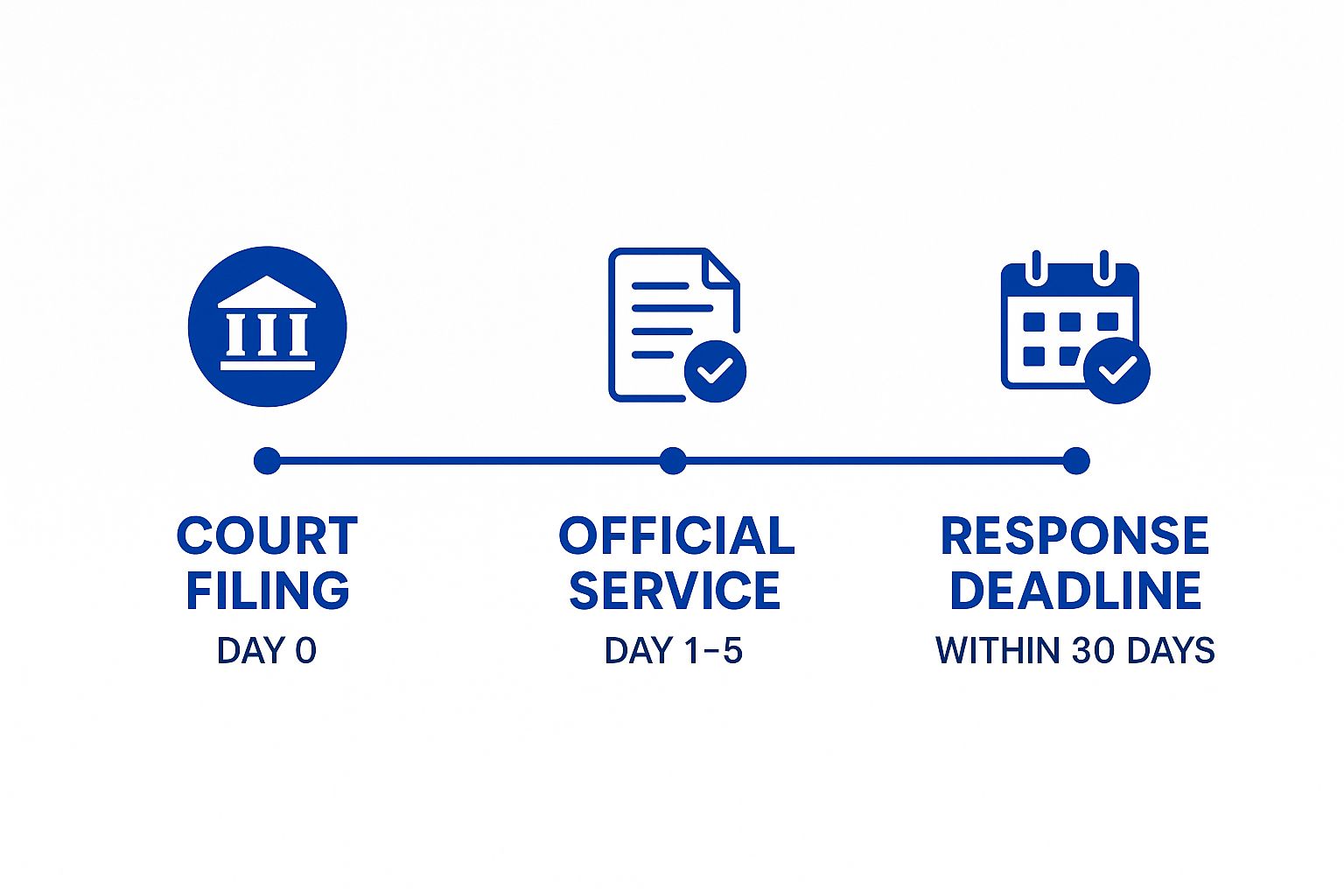
Once the papers are filed, your spouse has to be formally notified. This is service, and it is the step that most often invalidates an otherwise correct divorce.
Who can serve the papers
You cannot serve your spouse yourself. Service must be carried out by a process server, or by any other adult over 18 who is not a party to the case. Using a professional server costs money but produces a clean affidavit of service, which is what the court actually needs.
Service does not have to be confrontational. A neutral third party handling it keeps distance between you and your spouse at a point where that usually helps.
The response deadline depends on how service was done
This is where self-filed divorces most commonly go wrong, and the rule is specific:
- Papers personally handed to your spouse within New York State: they have twenty days to appear or answer
- Served any other way — substituted service, service on someone else at their home or workplace, or service outside New York: they have thirty days from the date service is complete
Filing for a default before the correct period has expired gets the packet rejected and returned, costing weeks. Note the service method and the exact date at the time it happens, because you will need both later.
What happens after service
Once served, your spouse has three options, and each sends the case in a different direction.
They agree. They sign the affidavit of defendant, confirming they consent and will not contest. This is the fastest route, and the case proceeds as an uncontested divorce.
They contest. They file an answer disputing some or all of what you have asked for. The case becomes contested, which usually means mediation, discovery, and possibly court appearances.
They do nothing. If the response period expires with no answer, you can proceed on default — the case moves forward on your papers alone, without their participation or signature.
Temporary orders while you wait
The gap between filing and judgment can be months, and bills do not pause for it. If you need support, a decision about who stays in the home, or a temporary parenting schedule in the meantime, the court can make temporary orders that hold things in place until the divorce concludes.
These are available whether or not the case is contested, and they matter most where one spouse controls the income or the accounts. They are temporary by design and do not determine the final outcome.
Communication and boundaries
While the case is pending, keep exchanges with your spouse in writing where you can, and keep a record of what was said and when. If the divorce stays amicable, you will never need it. If it turns contested, that record becomes the difference between what you remember and what you can show.
How long it takes
The paperwork itself can be prepared in days. What determines the timeline is the court’s calendar and how quickly your spouse responds.
| Type of divorce | Minimum | Typical | What extends it |
|---|---|---|---|
| Uncontested | A few months | Three to six months | Packets returned for correction, delays in service, court backlog |
| Contested | Six months plus | A year or more | Disputed property or custody, discovery, expert valuations, court calendars |
Anyone promising a specific number of days is describing the best case rather than the typical one. Queens, Kings and New York County all move at different speeds, and the same paperwork can take noticeably longer in one than another.
If your divorce turns contested
Sometimes a case that started as uncontested becomes contested — a spouse changes position, or an asset surfaces that nobody had accounted for. If that happens, the process changes shape.
Discovery is the formal exchange of information between the parties. It involves producing financial records, answering interrogatories — written questions answered under oath — and sometimes giving a deposition, which is oral testimony under oath before trial.
Discovery is where hidden income and undisclosed accounts surface, and it is also where disorganised record-keeping becomes expensive. The documents you gathered at the start earn their keep here.
Once a case is genuinely contested, self-representation stops being sensible. You are no longer filling in forms; you are litigating against someone whose interests are opposed to yours, usually with a lawyer on the other side.
Where self-filed divorces go wrong
Court clerks reject uncontested packets constantly, and the reasons repeat.
Service done incorrectly. Serving your spouse yourself, using someone under 18, or getting the timing wrong invalidates it. This is the most common failure and the most consequential, because a divorce built on defective service can be challenged years later — sometimes after one party has remarried or sold property relying on it.
Filing before the response period expires. Twenty days or thirty, depending on how service was done. Filing early gets the packet returned.
Incomplete child support paperwork. Agreeing between yourselves is not enough. The calculation has to be shown, and it has to follow the statutory formula. Courts will not simply approve whatever two parents have decided.
A vague settlement agreement. An incomplete agreement about property and debt creates problems later even when the court accepts it. Terms that felt obvious at the time become disputes when circumstances change.
Missing forms. The judgment package runs to a dozen or more documents. Omit one and the whole thing comes back.
When you should not do this yourself
Being honest about this matters more than the rest of the guide.
Don’t go it alone if you and your spouse disagree about anything material, or if there are children under 21 and you have not agreed support and custody in detail.
The same applies where there is a business, a pension, or property owned before the marriage. Classification and valuation are where the money is, and mistakes there are usually permanent.
If you suspect your spouse is not disclosing everything, self-filing gives you no mechanism to find out. Where there has been domestic violence, or where the power balance means you cannot negotiate freely, it is the wrong route entirely. And if your spouse has a lawyer, you are not in an even negotiation, whatever the tone of it feels like.
One point worth sitting with: a divorce judgment is difficult to undo. Property division generally cannot be revisited because you later realise you agreed to too little. If a pension was never properly divided, or a house was signed over on terms you did not fully understand, that is usually final. The saving on legal fees is visible immediately; the cost of a poor agreement shows up years later.
Getting help without paying for everything
It is not a choice between filing entirely alone and full representation. Several options sit in between.
Ways to buy less than everything
- Document review. An attorney reads your settlement agreement before you sign it. Inexpensive relative to full representation, and it catches the errors that matter most.
- Unbundled services. You handle the filing and hire an attorney for specific pieces — drafting the agreement, or appearing at one hearing.
- Legal coaching. You run the case; an attorney advises as you go. Expert guidance with you still in control.
- Full representation. The attorney handles everything. The most support, and the highest cost.
Free and low-cost resources
- Legal aid organisations provide free or reduced-cost help to people who meet income requirements
- Law school clinics offer assistance from students supervised by qualified attorneys, at reduced rates
- Court-based help centres explain procedure and forms, though they cannot give legal advice
Choosing an attorney
If you do hire someone, look for genuine family law experience in New York rather than general practice, clear and responsive communication, and a fee structure explained upfront in writing.
Worth asking at a consultation:
- What is your experience with cases like mine?
- How will you keep me updated, and how quickly do you respond?
- What do you estimate this will cost, and what does that figure include?
- What would you do differently from what I am planning?
Common questions
Do we both need to agree to the divorce?
You need agreement on the terms for the case to be uncontested. You do not need your spouse’s permission to divorce — New York allows a no-fault divorce on the ground that the marriage has broken down irretrievably for at least six months.
What if my spouse won’t sign anything?
You can still proceed. If they are properly served and do not respond within the time allowed, the case moves forward on default.
What if I can’t find my spouse?
You must show the court you made a genuine, documented search before it will permit service by publication. That is a separate application with its own requirements.
Can I use the free DIY program if we have a 19-year-old?
No. The program requires no children under 21, and New York’s support obligations run to that age.
Where do I get the forms?
Free from the New York courts. Never pay a third party for them — the courts prohibit anyone charging for access to the DIY program.
Can I start alone and get help later?
Yes, and many people do. Having an attorney review the settlement agreement before signing is the most common version, and the most useful.
How many certified copies of the judgment should I get?
At least two. You will need them for name changes, banks, insurance and pension administrators, and ordering more later costs time.
If your situation isn’t straightforward
An uncontested divorce with no children, no property in dispute and a cooperative spouse is genuinely a do-it-yourself matter, and we would rather say so than not. Where there are children, assets worth arguing about, or a spouse who is not being straight with you, a conversation before you file costs far less than fixing an agreement afterwards.
Call (718) 206-1555 to talk it through, or read more about uncontested divorce and our divorce practice.


Free Legal Consultation
98-14 Queens Blvd